
The short version
- Situation: Managing product across two business units, I identified inefficiencies in discovery, decision-making, and operational follow-through—highlighted by fragmented meeting data and ad-hoc processes.Problem: AI systems produce convincing output that may be incorrect or unchecked, risking operational errors and client trust.Solution: I designed and implemented two AI systems: “Groundwork” (for structured decision-making) and “El Ayudante” (for operational execution), with robust audit trails, agent roles, and verification protocols to ensure accuracy and accountability.Outcome: Both systems are live and supporting daily operations, improving problem detection, decision traceability, and process reproducibility across business units. Baseline metrics established pre-launch; impact measurement is ongoing.My role: Led an end-to-end product strategy, system design, implementation, and operational integration; overseeing decision-making, agent architecture, evaluation, and release management
From the field
From an 86-minute call transcript to a PWA running at a Volkswagen dealership, and prototype development for product improvement
Check them
> Iruña PWA Kiosk
40>15 min
from meeting to written NOTES
30+
4
Groundwork and "El ayudante" working togheter
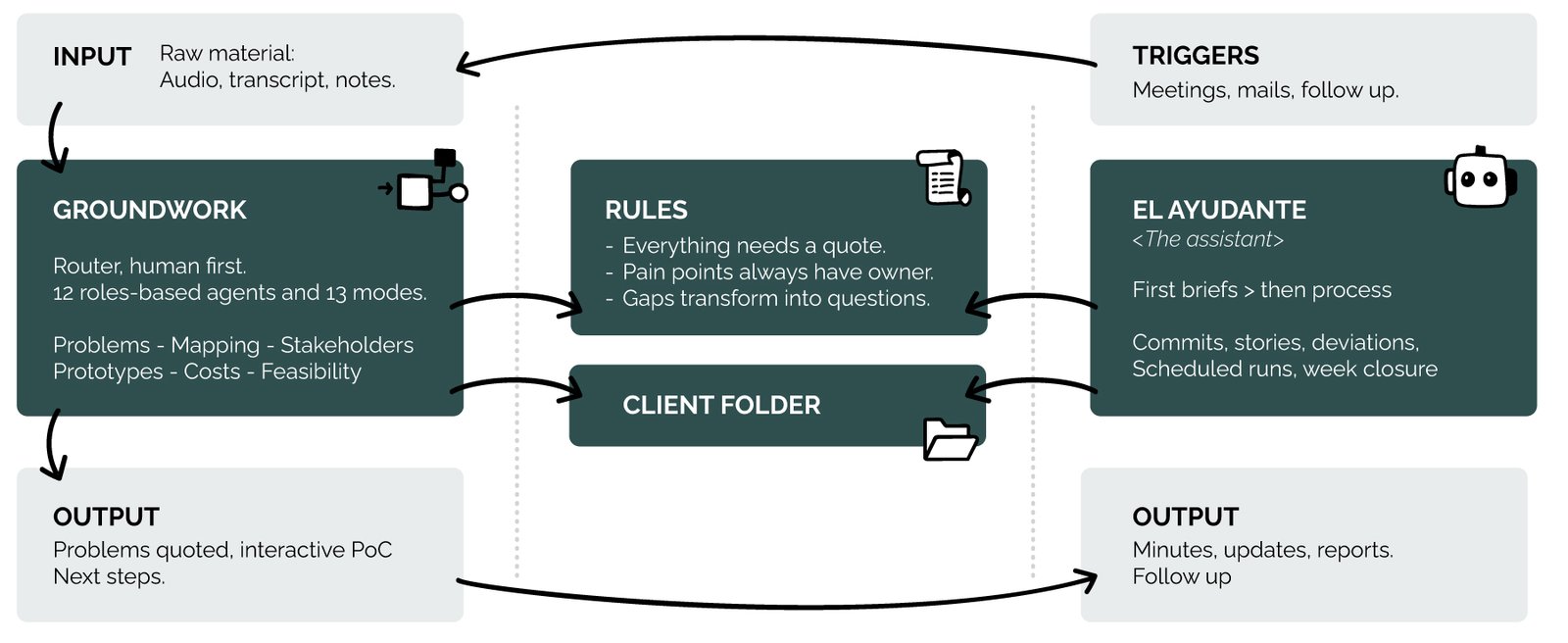
Groundwork drives decision-making; El Ayudante takes over to track commitments, deadlines, and progress.
Unstructured client input goes to Groundwork. Once a project is active, El Ayudante manages meeting briefs and reviews transcripts to extract action items, assign owners, and log decisions.
Its deviation radar highlights missed deadlines, recurring blockers, and risks. At week’s end, I get a complete operational snapshot—automatically compiled and ready for review, but always awaiting my approval before sharing.
The result: no more forgotten agreements or lost commitments. Every decision and promise is tracked, ensuring follow-through and accountability across all projects.
Designing against the failure mode
The rulebook every agent loads first puts it in one line: what a system like this produces when it fails is plausible, false text that reads well and nobody reviews.
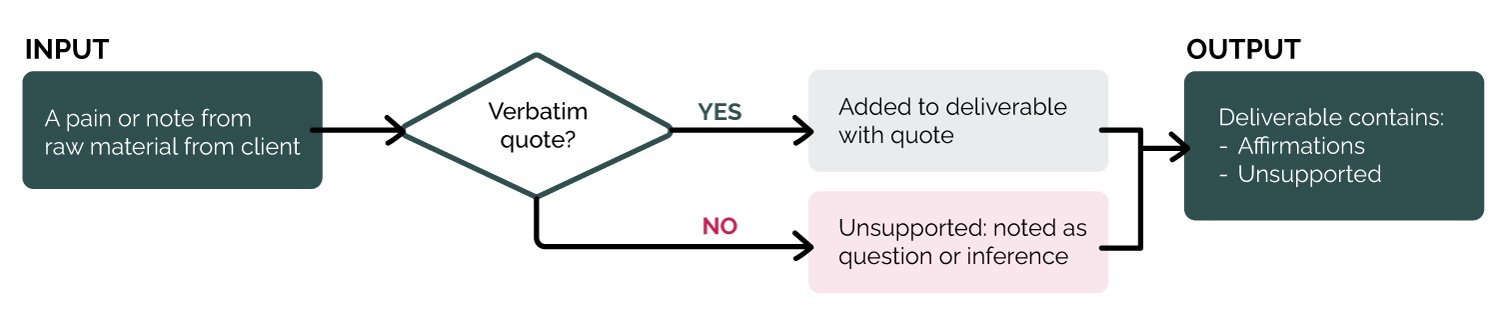
Every constraint below exists because of that sentence.
- Quote or it does not exist. Any statement about what a client said carries the verbatim line, who said it and the timestamp. No paraphrase inside quotation marks, ever. What has no quote goes into a separate section, declared as my inference.
- The pain belongs to someone. If you cannot name who is losing time, money or customers, it is an idea and gets labelled as one. My own team’s pain does not count. We are not the client.
- Gaps are declared and become questions. Admitting a hole is not enough. Each one is rewritten as a question a person can answer out loud on the next call, and it stays on the list until answered.
- Nothing is promoted by itself. No agent writes to the knowledge base or sends anything to a client without an explicit yes. Silence is not approval.
Measuring before building
Before either system existed I wrote a baseline of my own operation from four weeks of meeting metadata and commitments extracted by a tool rather than by me reading transcripts.
| Input | Value | Where it comes from |
|---|---|---|
| Meetings, four weeks | 19 | Meeting-tool metadata |
| Recorded meeting time | 16h 43m | Measured |
| Meetings per week, active weeks | 4.75 | 19 ÷ 4 |
| Meeting hours per week | 7h 00m | Measured, two full active weeks |
| Meetings I called myself | 18 of 19 | Measured |
| Commitments landing on my name | ~50 of ~170 | 29% of everything produced |
| Time with my own team, one month | 12 min | Measured |
| Write-up time after a meeting | 30 min | 10 min |
| Write-up time per week | 2h 22m | 4.75 × 30 min |
The value isn’t just time saved: it’s shifting work from writing to reviewing.
Six metrics track progress. Three are live: meeting hours by account, meetings I convene, and my commitments as a share of the total. Three will be measured soon: on-time completion, delivery lag, and post-meeting minutes.
How a run moves
Nothing runs until the routing step has answered four questions. Which account is this, and what do we already know? Does this material answer anything we had open. Which scope of work does it belong to. And did I name a focus.
A run does not end in a conclusion. It ends in the next conversation: three questions a person can answer out loud, the riskiest assumption and what would knock it down, three things to do next. If answering needs digging through a system, that is a task, not a question.
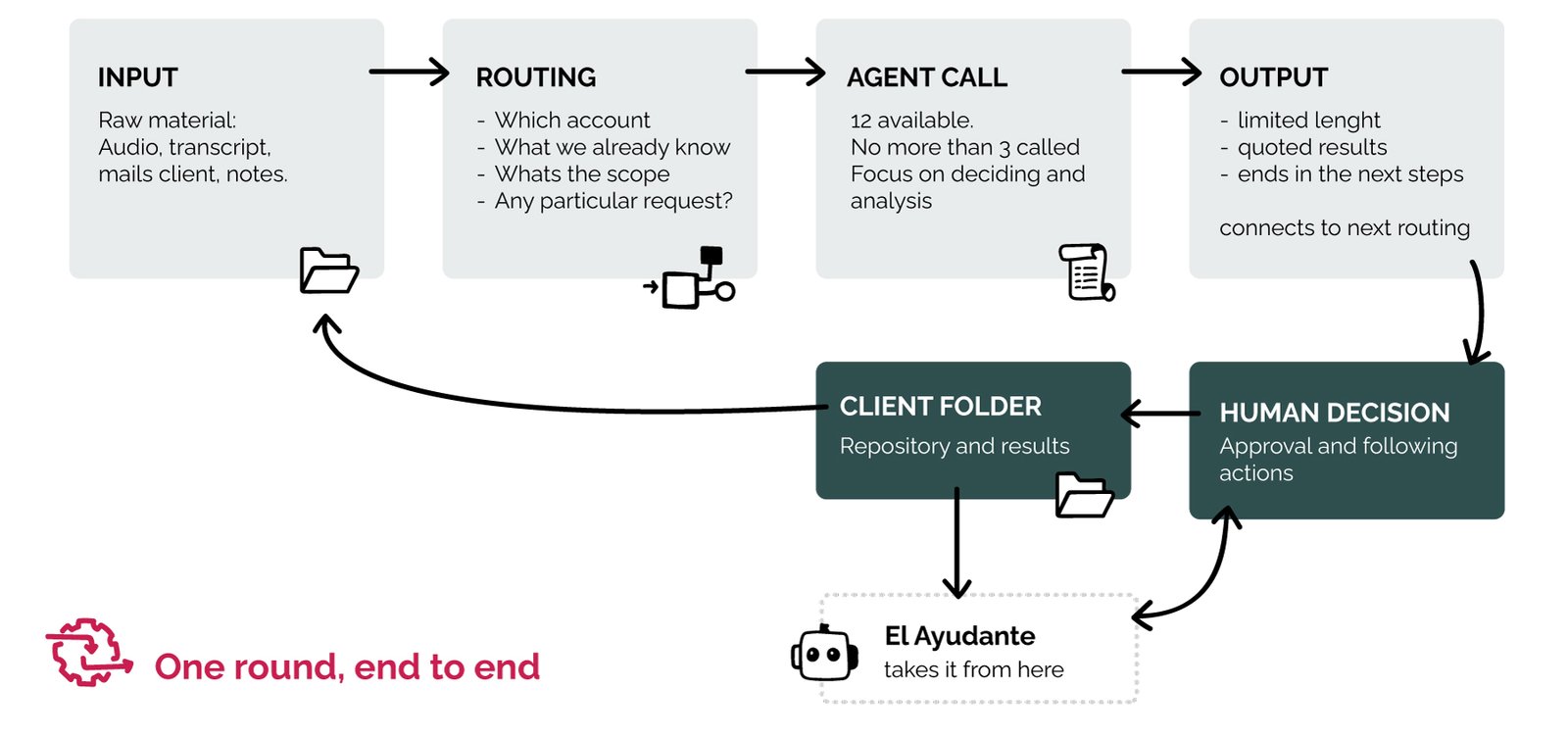
What the market asks for, and where it shows up here
| The ask | The evidence |
| AI literacy as a baseline competency | Two systems in daily use on live client work, one of them a published web app, the other an installable plugin at version 3. |
| Designing for probabilistic systems | The design problem was convergence: fixed output shapes, hard length caps, non-recycling IDs so the same problem stays recognisable across runs. |
| Multi-agent orchestration | Twelve agents, thirteen modes, a routing step that runs before anything else. Convening more than five agents in one run means you are collecting opinions instead of deciding. |
| Evaluation, trust | Four hard rules that never relax for a tidier output, and a run record that counts how many claims went out unsupported. The system grades itself and the number is written down. |
| Human-in-the-loop by design | Nothing reaches a client or the knowledge base without an explicit yes. Silence is not approval — that sentence is in the rulebook every agent loads first. |
| Measurement and instrumentation |
A written baseline taken before the systems existed, with its three blind spots declared in the document itself. Six metrics defined, three live, three waiting on integrations.
|
| Judgment alongside the tooling | The hardest calls were product calls, not prompt calls: what to cut, where the human gate belongs, and when to stop and say the material does not support the answer. |
Reflection
The real challenge wasn’t creating convincing specialist agents—that part came quickly. The critical work was setting clear boundaries: ensuring the system only answers with sources, stays on topic, and never promotes content without explicit approval.
A key insight: the greatest value often comes at the end of each session—not just in the findings, but in generating better next questions and surfacing assumptions that need to be tested. A system that consistently prompts stronger follow-up is more valuable than one that simply provides answers.
If I were to repeat this, I’d put even more focus on measuring impact in real time, making sure every improvement is tracked and actionable.
SKILLS
-
Multi-Agent Systems
-
LLM Workflows
-
AI Evaluation & Guardrails
-
Human-in-the-Loop
-
Prompt Architecture
-
Systems Design
-
Metrics
-
Plugin Development
-
Tool Design
-
Operating Model Design