
The short version
Situation
- A Volkswagen dealership running 4 different CRMs and an ERP with no API connections. Information scattered across systems, no unified process management, and no digital customer channels. Salesforce existed but was unusable — dirty data, no business unit flows mapped, inconsistent environments. Every process was manual, no one had visibility, and VW factory audits required a traceability the fragmented setup couldn’t guarantee.
Real problem
- Four layers of dysfunction. First: the CRM landscape was fractured — 4 systems that didn’t talk to each other, plus an ERP that blocked any integration. Second: Salesforce had no mapped flows — business units operated without defined processes inside SF. Third: there were no digital channels for customers — everything happened in person or by phone. Fourth: VW audit compliance demanded end-to-end traceability that simply didn’t exist.
What I decided
- Consolidate from 4 CRMs to 2 Salesforce instances (one mandatory for VW, one internal). Map, validate, and implement business unit flows from scratch. Build seven interconnected products on a unified Salesforce backbone: a WhatsApp bot for leads, support, bookings, test drives, and marketing campaigns linked to Meta; a document management portal tracking every step from prospect to vehicle delivery; a PWA for physical visit queue management; and a VW↔Internal Salesforce integration for audit compliance. All processes aligned to VW factory audit standards.
Outcome
- 4 CRMs → 2 Salesforce. 5-figure annual savings documented and growing. 280 hours/month saved in document management alone. Per-client time reduced from 95 min to 12 min. 155 leads/month automated into SF. One legacy platform fully decommissioned. Seven products shipped..
My role
- Product Lead & Business Manager, drove product and design direction across CRM consolidation strategy, business-flow mapping with 7 stakeholder groups, omnichannel architecture, and UI for all surfaces. Partnered with a PO and PM to coordinate a team of 7 including an architect, 2 developers, a UX/UI designer, and a QA.
admin & ops
streamlined per client
7
Products shipped in 1 year
155
The starting point: why 4 CRMs exist
When we arrived, the dealership had accumulated four CRM systems — each adopted by a different area at a different time — plus an ERP that didn’t allow API connections. Information lived in silos: sales couldn’t see what post-sales was doing, finance tracked things in spreadsheets, and management had no unified dashboard.
Salesforce was already there, but it was barely functional. No business unit flows had been mapped inside it. Data was dirty, environments were inconsistent, and nobody trusted what the system said. The first job wasn’t building anything — it was understanding what each business unit actually did, then cleaning, mapping, and homologating the Salesforce environments before a single new feature could ship.
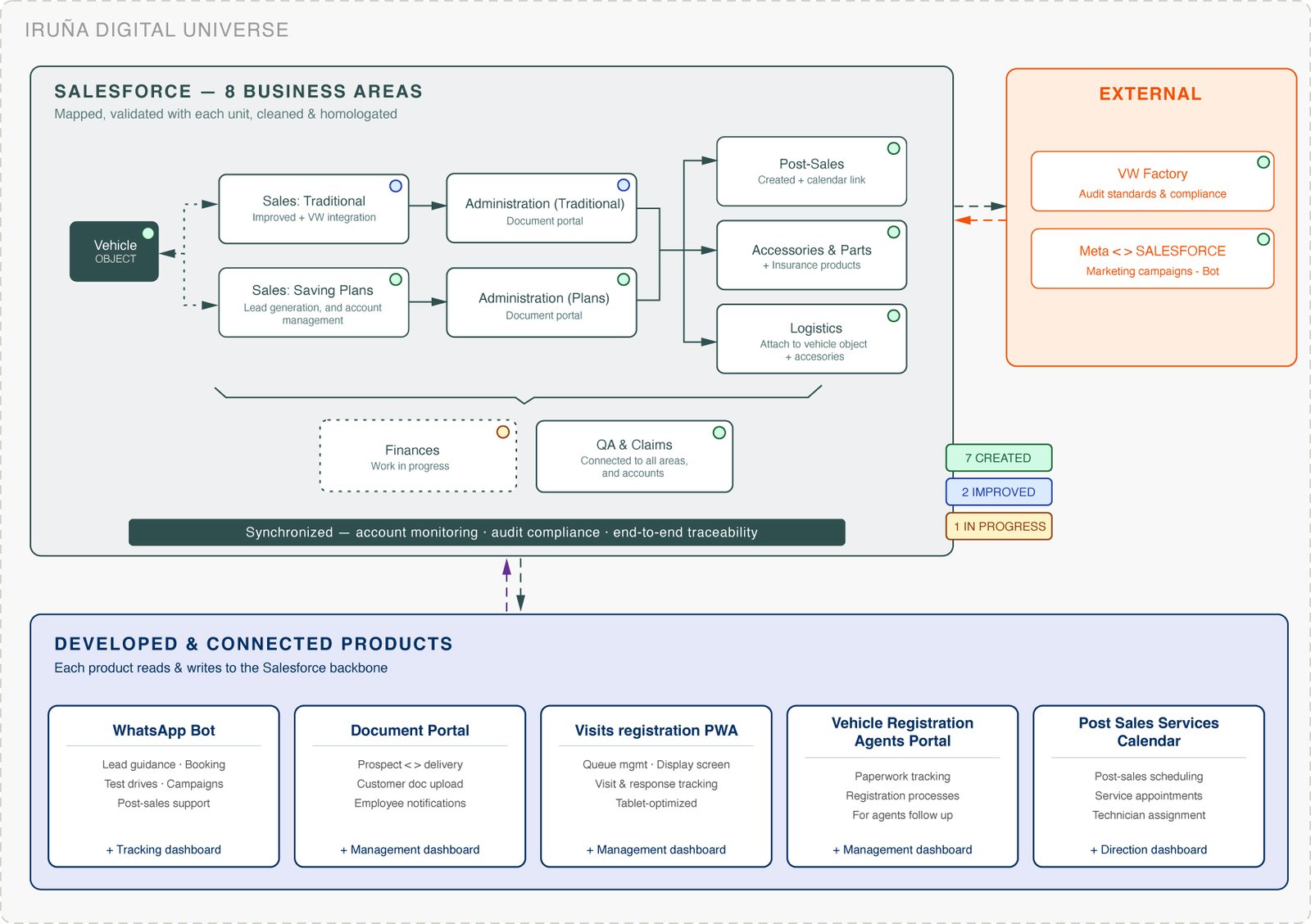
The consolidation strategy: keep the VW-mandatory Salesforce (non-negotiable — factory audits require it), build a second internal Salesforce as the operational backbone, and connect both. Everything else gets retired
What we built: 7 products, one backbone
1. CRM consolidation & SF cleanup — Reduced 4 CRMs to 2 Salesforce instances. Mapped every business unit flow, validated with stakeholders, cleaned data, and homologated environments. This was the foundation everything else sits on.
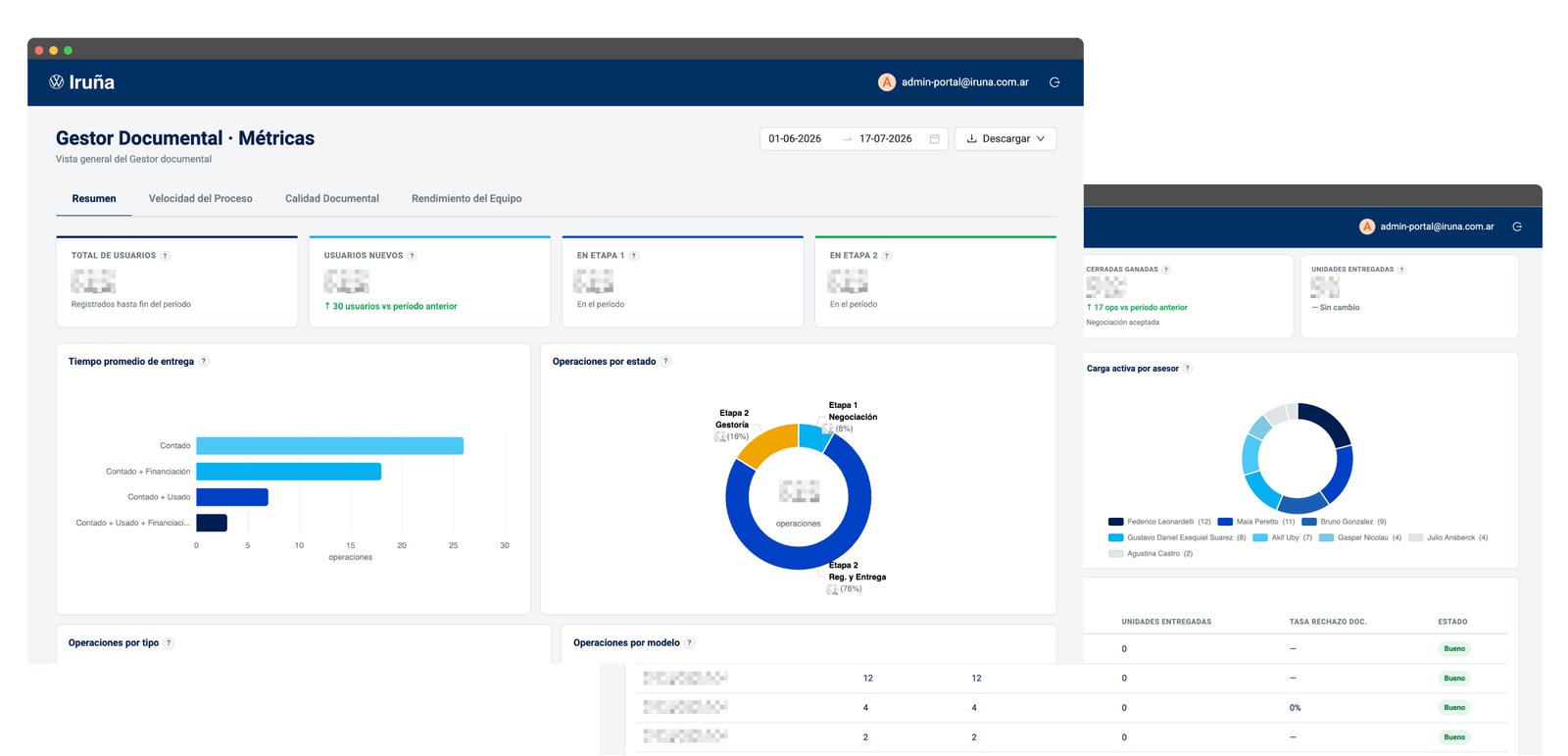
2. WhatsApp conversational bot — Guides customers through vehicle information, advisor booking, post-sales support, and test drive scheduling. Handles marketing campaigns linked to Meta and Salesforce. Includes a management dashboard for tracking conversations, conversions, and campaign performance. All interactions register directly in Salesforce. Impact: 100 leads/month automated into SF, 2.5 min avg test drive booking, 25 hrs/month saved.
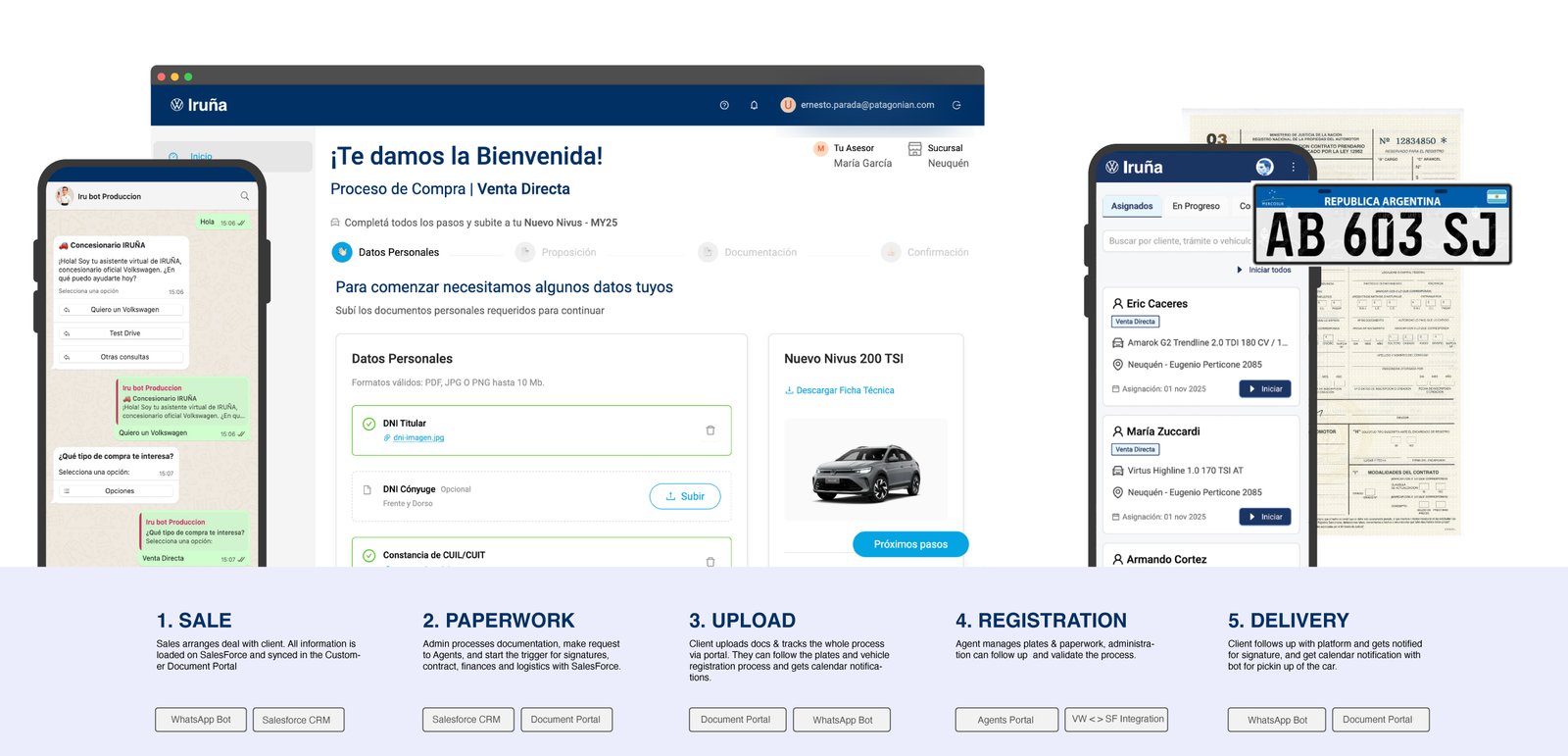
3. Document management portal — Covers the entire lifecycle from prospect creation to vehicle delivery. Every area involved in the process has visibility. Customers can track their status, upload missing documents, and all linked employees receive notifications. Built with a management dashboard. Impact: per-client time reduced from 95 min to 12 min (gestor assignment 15→0.5 min, doc validation 45→10 min, status tracking 20→1 min, client comms 15→0.5 min). 140 hrs/month saved.
4. Physical visit PWA — A tablet-optimized progressive web app for managing walk-in appointments at the dealership. Includes a queue display screen for the showroom, queue management, visit tracking, response time monitoring, and a management dashboard — all stored in Salesforce. Impact: 15 hrs/month saved at reception.
5. VW ↔ Internal Salesforce integration — Connects the factory-mandatory VW Salesforce with the internal instance to maintain account monitoring and ensure factory audit compliance across both systems. Impact: eliminated manual sync between SF instances, ensuring audit compliance.
6. Vehicle Registration Agents Portal — A portal for paperwork managers (“gestores de trámites”) to track vehicle registration and documentation processes.
7. Service calendar — Post-sales service scheduling system for technician appointments and service management.
Company Digital Universe - Graph
Design decisions & trade-offs
- Two Salesforces, not one — VW’s Salesforce is mandatory and non-negotiable. Instead of fighting the constraint, we embraced it: VW’s instance handles factory compliance, the internal one handles operations. The integration layer keeps them in sync.
- Channel specialization over channel duplication — WhatsApp handles quick interactions (schedule a test drive, ask a question, run a campaign). The portal handles documents, status tracking, and notifications. The PWA handles physical visits. Each channel does what it does best.
- Audit-first architecture — Every process was designed with VW factory audits in mind. Traceability isn’t an afterthought — it’s built into every flow, every notification, every status change.
- Map before you build — The first months were pure discovery: mapping existing processes with each business unit, validating flows, cleaning Salesforce. No product work started until the foundation was solid.
Reflection
This project taught me that digital transformation isn’t about technology — it’s about organizational alignment. The hardest work wasn’t building six products; it was getting seven stakeholder groups to agree on how their processes actually work, then convincing them to trust a unified system.
The CRM consolidation alone took weeks of mapping, negotiation, and cleanup. Every business unit had built their own workflows around their own tools, and each believed their way was the “real” process. The product work only became possible once we created a shared language — the mapped flows inside Salesforce became not just technical artifacts but organizational agreements.
The audit compliance dimension adds a layer most product designers never face: every design decision has regulatory implications. A missing notification isn’t just a UX gap — it’s an audit finding. That constraint shaped every flow.